
Is Cage-Free Really Cage-Free?
When you buy your eggs, do you pay attention to the small description in the title? You probably notice the small detail explaining that the eggs are very fresh because they are from cage-free chickens. But did you know that these may not actually mean what they say? Let’s dive deeper into what your egg carton truly says about your eggs.
1. “Caged eggs”/ “Battery Eggs”
This is most true to its name. The chickens that lay the eggs you see in a carton labeled “caged” are really caged. There, hens are confined in small, barren cages, often leading to extreme stress, high injury rates, and the inability to engage in natural behaviors. Chickens within these cages develop stress-induced injuries from being confined in tight spaces with other moving chickens. The Humane League dives into the physical tortures these birds go through, like a “host of foot disorders,...thanks to the sloping floors of cages”,” Overgrown claws are also common, since chickens cannot engage in ground”,” bone fragility”, “osteoporosis”, and even “a syndrome called cage layer fatigue, which can cause birds to become paralyzed”.
“In cage systems, 6 to as many as 12 hens are crammed into metal wire cages. In those cages, each hen has less than an iPad’s worth of space to move around. And this is how they live for almost their entire lives.” - ciwf.com
Recently, thanks to growing awareness and public pressure, lawmakers and corporations rethought their battery cages. Several states in the US have passed legislation that either banned or limited the use of these extreme confinements. One of the most influential of these laws is California’s Proposition 12, which was passed in 2018. Proposition 12 requires egg-laying hens to be given a greater set of usable space per bird, also effectively banning traditional battery cages within the state. Similar legislation has been enacted in states such as Massachusetts, Michigan, Washington, and Oregon.
As consumer awareness grows, large corporations like McDonald’s, Cosco, Target, and more also started committing to sourcing only cage-free eggs.
This sounds like great progress, but the reality of cage-free farming is still not the best treatment we should stick to with our chickens. Although producers have shifted from battery cages to cage-free systems, the conditions have not improved. For many hens, life in a cage-free facility still involves similar issues, such as overcrowding and disease spreads.
2. “Cage-free”
With Cage Free farms, chickens are allowed just a bit more room. Although it can vary, the birds are essentially placed by a handful together into slightly wider enclosures. At least they’re able to walk around a couple of feet and adjust their wings, right?
Well, not exactly. The New York Times discusses how these conditions are still considered inhumane, explaining that “while cage-free aviaries may let hens stretch their wings, they’re not necessarily better for the health of the animals, or the workers.”
In many cage-free systems, there are thousands of birds packed into massive warehouse-style barns. In reality, there’s no big difference between the battery egg cages because crowding is still not eliminated. The Animal Place reports that cage-free farms often contain 60,000 to 100,000 birds in one shed, leading to aggressive behaviors such as pecking, trampling, and even cannibalism. With so many chickens living in close quarters, disease spreads quickly, and farms are then forced to rely heavily on antibiotics.
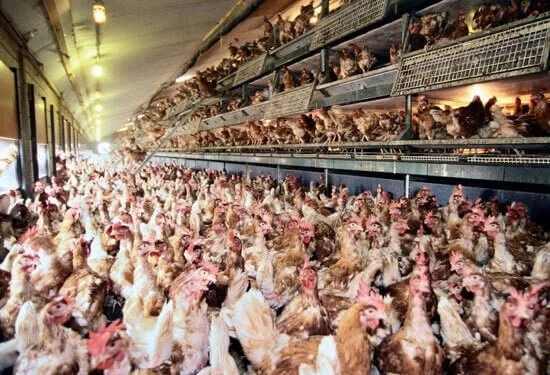
Image Source: PETA
Alongside the issue of animal cruelty sprout major environmental concerns. Cage-free operations create enormous amounts of concentrated waste, which can contaminate local water supplies and release ammonia into the air. The National Library of Medicine states that poultry farms are one of the leading contributors to nutrient pollution, and according to the Environmental Protection Agency, nutrient pollution in waterways can cause toxic algae blooms that harm our aquatic ecosystems.
This leads consumers to seek out what seems like a better option: Free-range eggs
3. “Free-range”
Free-range eggs come from hens that are given access to the outdoors…or so in theory. In the United States, the USDA requires that free-range hens have “access to the outdoors”, but the regulation does not specify things to an extent so that as a result, some farms are able to find loopholes and do things like legally label its eggs “free-range” despite their hens only having access to, say, a small concrete porch or a rarely opened narrow door to the yard.
Compared with cage-free and battery systems, free-range farming does offer some significant improvements. Firstly, chickens are given the opportunity to breathe fresh air, experience natural light, and engage in basic but necessary behaviors such as walking, dust bathing, and foraging. Studies published in ScienceDirect support data that find hens with outdoor access displaying “better feather conditions and reduced stress levels.”
However, free-range systems still have serious flaws. Overcrowding remains common, and many chickens never actually make it outside, commonly due to poor barn design, the owner's fear of predators, and more.
Additionally, environmental impacts persist, as manure runoff and land degradation remain major challenges.
While free-range farming represents progress, it still falls short of providing chickens with a truly natural and humane life.
4. “Pasture-Raised”
Pasture-raised eggs come from hens raised outdoors on rotating pastures, where they’re free to roam, forage, and express their natural behaviors throughout the entire day. Unlike free-range standards, pasture-raised systems typically require 108 sq ft or more per bird, thereby allowing chickens to live in conditions closest to those in their natural environment (Certified Humane).
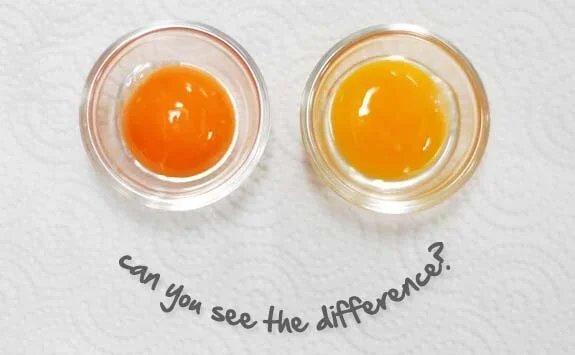
Source: Higher Oak Farm
Pasture-raised systems minimize chickens’ stress, promote healthier immune systems, and significantly improve their welfare. Chickens raised on pasture also produce eggs that are richer in nutrients. Just look at this visual from Higher Oak Farm, comparing free-range (left) to battery-hen eggs (right)!
The environmental benefits are equally impressive. Rotational grazing, in which livestock are systematically moved between fenced pastures to allow grazed areas to rest, allows chickens to naturally fertilize the soil and minimize waste runoff (Rodale Institute). Farms that use regenerative pasture systems report healthier soil, increased biodiversity, and lower carbon emissions (SOURCE). Economically, these farms often support small-scale agriculture, retaining capital within local communities and promoting ethical food systems.
For consumers in New York City, pasture-raised eggs are not far from reach! They can be found at grocery stores such as Whole Foods, Trader Joe’s, and local farmers’ markets (my favorite is the weekly farmer’s market in Union Square!). Alternatively, you can utilize your search engine and research if certain egg brands sell pasture-raised, or check out this website that did some of the work for you!
So.. Is Cage-Free Really Cage-Free?
The short answer? No! While cage-free systems may eliminate the cruel metal wire enclosures, they often replace them with massive, overcrowded barns that still keep the overcrowding.
Understanding egg labels allows us consumers to make informed choices, and hopefully, we can push the industry towards more animal-friendly, humane practices.
