
When Nets Don’t Let Go: How Ghost Gear Traps Ocean Wildlife and How You Can Help
By Sienna Gaetani

In many parts of the ocean, old fishing gear becomes part of the aquatic landscape. Made from durable plastics, nets can linger in the water for years. Even on the seafloor, these nets continue to trap marine life long after they’re discarded. According to the Environmental Literacy Council, there is an estimate that each year, about 650,000 marine animals are killed or severely injured by ghost nets. This makes ghost gear one of the deadliest forms of marine debris. Clearly, lost ghost gear isn’t a rare occurrence.
Around the world, ghost gear is the leading cause of entanglement for whales, turtles, and seabirds. Ghost gear is defined as fishing gear that has been abandoned, lost, or discarded into the ocean, posing a danger to wildlife and increasing ocean pollution (World Wildlife Fund). Researchers at the Environmental Investigation Agency estimate that more than 640,000 tons of fishing gear enter the ocean each year, and because most of it is made from durable plastics, it can persist for decades. Ghost gear is a pressing problem, actively trapping marine life. It captures and endangers aquatic animals that hunt, eat, and migrate across oceans every day.
Because marine life is constantly on the move, it is likely to unknowingly swim into a net. When entangled in ghost gear, different animals face struggles of suffocation, infection, exhaustion and even immediate death. According to NOAA fisheries, “Smaller marine animals, like sea turtles, seals, porpoises, dolphins, and smaller whales, may drown immediately if the gear is large or heavy.”
Getting out of nets creates a big problem, especially for large animals that don’t possess enough mobility to shimmy their way out of them. In fact, the struggle to escape may entangle these animals even more, increasing the deadly risk of suffocation. According to the World Wildlife Fund, “Many animals that get caught or entangled in ghost gear can die a slow and painful death through suffocation or exhaustion.”
To fix this problem, many researchers, fishers, and conservation groups are trying their best to reduce the risks and accumulation of ghost gear. Simple changes, like attaching LED lights to gillnets, have been shown to prevent marine wildlife entanglement during fishing, cutting back on the amount of bycatch caught by fishers. According to the World Economic Forum, “fishing nets that glow green with LED lights may prevent sea turtles, sharks and rays, including many threatened species, from becoming accidentally entangled.” As found in a study by Senko et. al., implementing these lights decreased overall bycatch by 63% and even reduced the number of entangled sharks, skates, and rays by 95%.
Transmitting devices called “pingers” are used by some fishers to warn off dolphins and whales. As described by the Whale and Dolphin Conservation in Wales, pingers “emit a repeated audible signal which alerts individual harbour porpoises to the presence and location of the nets, significantly reducing the likelihood of them becoming entangled.” Using this device is low-cost and are fairly easily for fishermen to start using. The Whale and Dolphin Conservation found that pingers have shown to be effective in reducing bycatch.
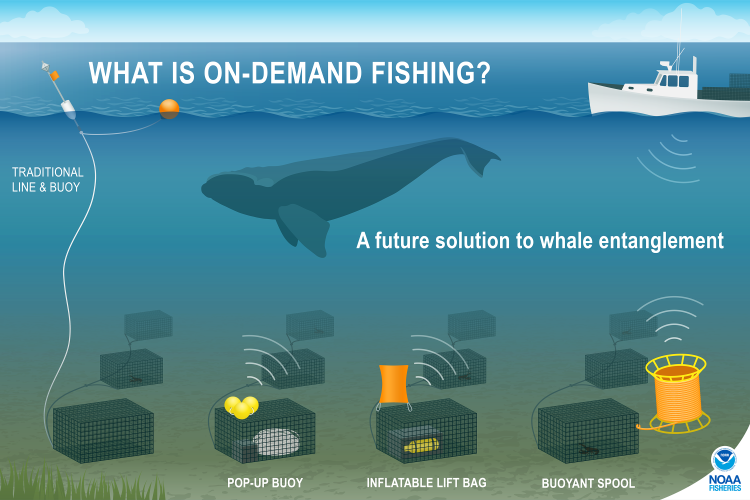
Source: NOAA
Long ropes that connect seafloor fishing cages to the fishing boat are problematic because they can entangle both large and small sea creatures. Ropeless traps can significantly reduce the risk of entanglement for marine species. Inventions like pop up buoys and inflatable lift bags can reduce the risk of these ropes. The NOAA shared that their reduced use of buoy lines has shown to be their most effective strategy in reducing entanglement risk.
Communities across the world are also adding gear-recycling bins and retrieval programs, encouraging fishers to bring back damaged nets instead of discarding them at sea. You can learn more about these solutions on the GGGI website. Additionally, in New York City, some hardworking groups and programs clean up plastics and landfill from our harbor to better the lives of wildlife. If you are interested in their efforts, check out the Hudson River Park’s shoreline cleaning crew, The NYC Surfrider organization, and the Littoral Society Organization’s coastal cleanup group.
If you’re living in New York City, a solution you can start today to aid the ghost gear problem is by following NYC GOV’s recycling plan to make sure your disposals are not ending up in the water. While no single fix solves the problem, simple efforts like these show that everyone can do their part for the environment.
Speaking of these programs, you can help reduce the toll of ghost gear by supporting fisheries that use bycatch-reduction technologies. To do this, you could donate to impactful initatives or volunteer at local cleanup and retrieval programs–you have the power to significantly strengthen local and large-scale group efforts to remove lost gear from the water. Even small acts, like reporting drifting nets spotted along beaches or in harbors, can make a difference.
As grocery consumers, we can also look for seafood certifications that prove responsible gear use. Look for labels like the Aquaculture Stewardship Council (ASC) on wild-caught seafood and the Best Aquaculture Practices (BAP) labels for farmed seafood. Read this article by the Green Stars Project that offers a useful guide on what seafood certifications to look for at your local market.
Small actions like these can support the broader shift toward safer, more sustainable oceans.
Ghost gear isn’t unavoidable. Practical solutions exist, and organizations are working on implementing them–and so can we.
Source: isealalliance.org

Source: seacoreseafood.com
